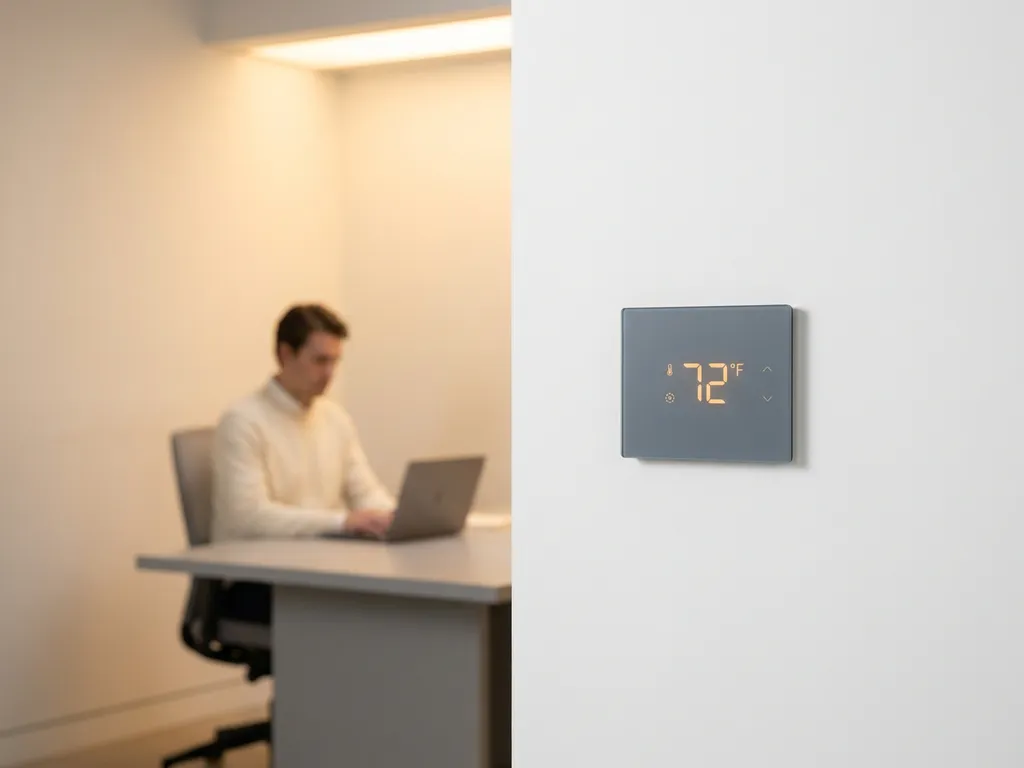
Temperature control technology plays a direct role in employee comfort by maintaining thermal conditions that reduce physical distraction and support sustained focus. When office temperatures fall outside a comfortable range, concentration drops, errors increase, and employees feel less motivated to spend time in the workplace. This article unpacks how office temperature affects productivity, why disagreements arise, and how smart systems are changing the way organizations manage thermal comfort.
How does office temperature affect employee productivity?
Office temperature has a measurable impact on employee productivity. When the thermal environment feels too hot or too cold, the body diverts cognitive resources toward physical discomfort rather than focused work. Research consistently links temperatures outside the comfortable range with reduced concentration, slower task completion, and higher error rates. Getting the temperature right is one of the most straightforward ways to protect output.
The effect is not just physical. Thermal discomfort also shapes how employees feel about their workplace. A persistently cold open-plan office or a stuffy meeting room signals a lack of care for the people using the space. Over time, this erodes engagement and makes employees less inclined to come into the office at all, which matters especially for organizations trying to build a meaningful hybrid work culture.
The impact is also uneven across different types of work. Deep-focus tasks, creative problem-solving, and collaborative discussions each benefit from slightly different conditions. A workspace that feels comfortable during a brainstorming session may feel stifling during concentrated individual work. This is one reason static thermostat settings often fall short.
What is temperature control technology in the workplace?
Temperature control technology in the workplace refers to systems and tools that monitor, regulate, and adjust indoor thermal conditions to maintain comfortable and energy-efficient environments. At its most basic, this includes programmable thermostats and zone-based HVAC systems. At its most advanced, it encompasses sensor-driven smart HVAC systems that respond to real-time occupancy, weather data, and individual preferences.
Modern workplace temperature control typically involves several layers working together:
- Occupancy sensors that detect whether a space is in use and adjust heating or cooling accordingly
- Zone controls that allow different areas of an office to be managed independently
- Smart thermostats that learn usage patterns and anticipate demand
- Integration layers that connect HVAC systems with booking platforms, calendar data, and facility management software
- Dashboards and analytics tools that give facility managers visibility into thermal performance across the building
Together, these components form what is increasingly called a smart HVAC office setup, where temperature management moves from reactive to proactive.
Why do employees disagree about the ideal office temperature?
Employees disagree about the ideal office temperature because thermal comfort is genuinely personal. Metabolic rate, clothing choices, body composition, age, and individual physiology all influence how a person experiences the same room temperature. What feels perfectly comfortable to one colleague can feel uncomfortably cold or warm to another sitting just a few desks away.
There are also structural factors at play. Open-plan offices create microclimates where sunlight, proximity to windows, airflow from vents, and heat from equipment all vary significantly across the floor. Someone seated near a south-facing window in summer will have a very different experience from a colleague sitting in a central aisle.
Gender differences in thermal preference are also well documented in workplace research. Studies have observed that women, on average, tend to prefer slightly warmer temperatures than men, partly due to differences in resting metabolic rate. This does not mean temperature policy should be built around generalizations, but it does reinforce why a one-size-fits-all thermostat setting will always leave some employees uncomfortable.
The practical takeaway for facility managers is that the goal is not to find a single perfect temperature but to create enough flexibility and zoning that different preferences can be accommodated across different spaces.
How does smart temperature control integrate with workplace management systems?
Smart temperature control integrates with workplace management systems by connecting HVAC behavior directly to real-time data about how and when spaces are being used. When a meeting room is booked, the system can begin conditioning the space ahead of the meeting start time. When a desk area is empty, heating or cooling can be scaled back automatically. This integration closes the gap between building infrastructure and actual human activity.
The most effective integrations work in both directions:
- Booking data informs HVAC: Room and desk reservations trigger pre-conditioning so spaces are at the right temperature when employees arrive, not ten minutes after they sit down.
- Occupancy sensors inform booking systems: If a booked room is actually empty, the system can release the space and reduce energy use simultaneously.
- Analytics close the feedback loop: Usage patterns over time reveal which spaces are consistently over- or under-conditioned, enabling smarter scheduling and infrastructure decisions.
Our smart office platform supports this kind of integration by combining desk and room booking with occupancy sensing, giving facility managers the real-time and historical data they need to connect space usage with building system performance. When temperature control technology and workplace management share the same data layer, the office becomes genuinely responsive rather than just programmable.
What are the energy and cost benefits of automated temperature control?
Automated temperature control reduces energy consumption and operational costs by ensuring that heating and cooling are only applied where and when they are actually needed. Traditional HVAC systems condition spaces on fixed schedules regardless of occupancy, which means significant energy is spent maintaining comfortable temperatures in empty rooms. Automation eliminates that waste by tying system behavior to real demand.
The cost benefits compound over time in several ways. Energy bills decrease as the system stops conditioning unused spaces. Maintenance cycles can be extended because equipment runs less during low-demand periods. And as energy costs continue to rise, the financial case for smart HVAC in office environments becomes stronger with each passing year.
There is also a sustainability dimension that matters to an increasing number of organizations. Reducing unnecessary energy consumption directly supports carbon reduction targets and ESG reporting commitments. For facility managers who need to demonstrate environmental progress to leadership, automated temperature control provides both the impact and the data to back it up.
How can facility managers use temperature data to improve the workplace?
Facility managers can use temperature data to identify patterns of discomfort, inefficiency, and underperformance across the office and make targeted improvements. Rather than responding to individual complaints after the fact, data-driven temperature management allows proactive decisions based on how conditions actually vary across zones, times of day, and seasons.
Practical applications include:
- Identifying problem zones: Consistent temperature anomalies in specific areas point to HVAC inefficiencies, poor insulation, or equipment placement issues that can be addressed directly
- Optimizing pre-conditioning schedules: Data on arrival patterns helps set more accurate warm-up and cool-down times, reducing energy waste without compromising comfort
- Supporting space planning decisions: Temperature data combined with occupancy data reveals which areas employees avoid and why, informing layout changes or investment priorities
- Building the business case for upgrades: Documented evidence of energy waste or comfort issues gives facility managers concrete data to justify HVAC investment to finance teams
Temperature data is most powerful when it sits alongside other workplace metrics. Occupancy rates, booking patterns, and employee feedback together paint a complete picture of how the office is performing, not just as a building, but as a place people genuinely want to work.
How GoBright helps with workplace comfort and smart office management
Creating a comfortable, efficient workplace goes beyond adjusting the thermostat. It requires connected systems that give you visibility into how your office is actually being used, and the tools to act on that insight. That is exactly where we come in.
GoBright’s smart office platform supports facility managers and operations teams in building a workplace that works for everyone:
- Occupancy sensors that provide real-time and historical data on space usage, enabling smarter conditioning schedules and space planning decisions
- Desk and room booking that integrates with Microsoft 365 and Google Workspace, so your HVAC and workplace systems can share the same demand signals
- Workplace analytics that surface patterns in how and when spaces are used, giving you the evidence base to improve comfort, reduce waste, and optimize your office layout
- A unified platform that connects booking, occupancy, visitor management, and digital signage in one place, reducing the tool complexity that makes facility management harder than it needs to be
If you are looking to make your office a place employees genuinely choose to come to, thermal comfort is part of the picture, and data is the starting point. Get in touch with us to explore how GoBright can support your smart office strategy.
Frequently Asked Questions
What is the ideal office temperature range for productivity?
Most workplace research points to a range of 70–77°F (21–25°C) as the sweet spot for cognitive performance and comfort, though the right target will vary depending on the type of work being done and the individual preferences of your team. Rather than chasing a single fixed number, the more effective approach is to use zoning and smart controls to maintain different conditions in different spaces — slightly cooler for focused individual work, slightly warmer for collaborative areas. The goal is flexibility, not uniformity.
How do I get started with smart temperature control if my office still uses a traditional HVAC system?
You don't need to replace your entire HVAC infrastructure to start benefiting from smarter temperature management. A practical first step is adding smart thermostats and occupancy sensors to your existing system, which can immediately reduce energy waste in unused spaces and give you basic data on usage patterns. From there, integrating those sensors with a workplace management platform like GoBright allows you to build toward fully automated, demand-driven conditioning without a full system overhaul. Start with the data layer — visibility always comes before optimization.
What are the most common mistakes organizations make when managing office temperature?
The most common mistake is applying a single thermostat setting across an entire floor and treating it as a solved problem. This ignores the microclimates that naturally develop in open-plan offices, the variation in how different employees experience the same temperature, and the fact that comfort needs change throughout the day. Another frequent misstep is conditioning spaces on fixed time schedules rather than actual occupancy, which wastes significant energy on empty rooms. Both mistakes are solvable with the right combination of zoning, sensors, and integration with real-time booking data.
How can I handle ongoing temperature complaints from employees without constantly adjusting the thermostat?
Persistent complaints are usually a signal that your current setup lacks the zoning granularity or flexibility to accommodate different preferences — not that you need to find a better single setting. The most effective response is to create clearly differentiated thermal zones across your office, so employees can self-select into spaces that suit their preferences, and to supplement HVAC with localized solutions like desk fans or personal heaters where full zoning isn't feasible. Sharing occupancy and temperature data with employees can also help — when people understand why a space feels the way it does, complaints often shift into constructive feedback.
Can smart temperature control really make a measurable difference to energy costs, and how quickly?
Yes — organizations that move from fixed-schedule HVAC to occupancy-driven automation typically see meaningful reductions in energy consumption, with some studies and case reports citing savings in the range of 20–30% on HVAC-related energy use. The timeline to measurable impact depends on your building's size, current inefficiencies, and how tightly your new system is integrated with real occupancy data, but most facilities begin to see differences within the first few billing cycles. The savings compound over time as the system learns usage patterns and pre-conditioning schedules become more accurate.
How does temperature control fit into a broader hybrid work strategy?
Thermal comfort is one of the most immediate and physical reasons employees choose to stay home rather than come into the office — if the space feels uncomfortable, no amount of collaboration tools or perks will fully compensate. In a hybrid context, smart temperature control also needs to account for unpredictable occupancy patterns, since the office may be full on some days and near-empty on others. Tying HVAC behavior to desk and room booking data ensures the office is always ready when people arrive, without wasting energy on days when attendance is low — which directly supports the case for making the office a destination worth choosing.
What should I look for when evaluating workplace temperature control or smart HVAC solutions?
Prioritize solutions that offer real-time occupancy sensing, zone-level control, and integration with your existing workplace management or booking platform — these three capabilities are what separate genuinely smart systems from glorified programmable thermostats. You should also look for robust analytics dashboards that surface trends over time, not just live readings, since historical data is what enables proactive decisions rather than reactive fixes. Finally, check how easily the solution connects with tools your team already uses, such as Microsoft 365 or Google Workspace, to avoid creating yet another siloed system that facility managers have to manage separately.