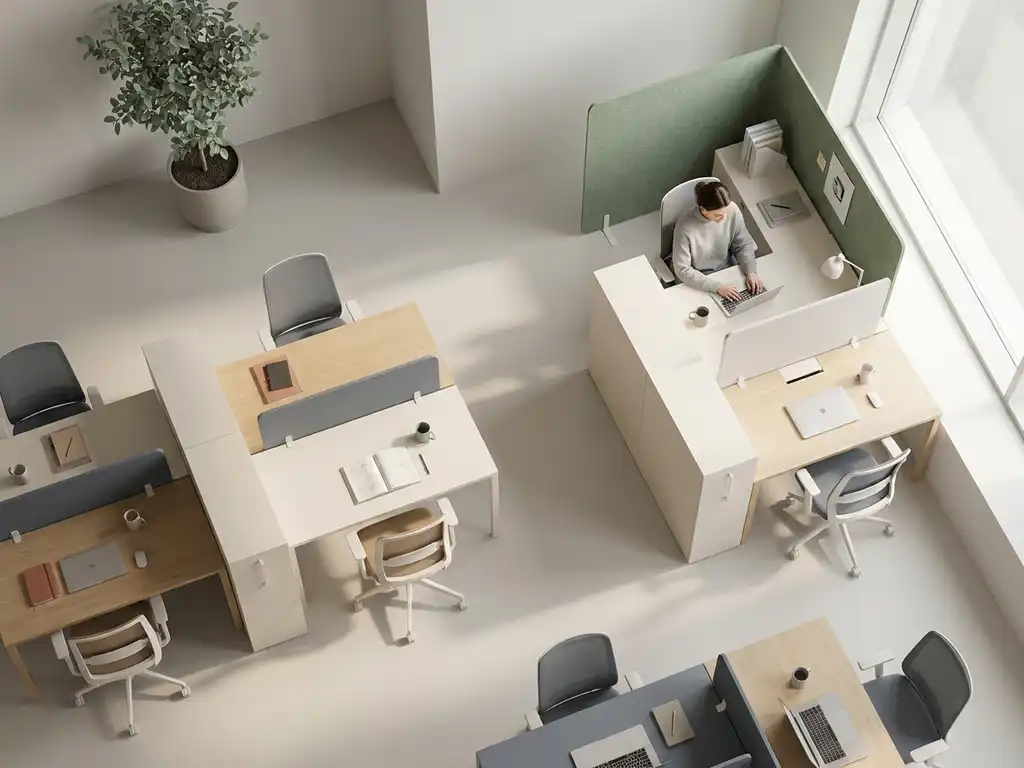
Workplace culture directly shapes space utilization by determining how, when, and whether employees actually use the office. Organizations with rigid, attendance-focused cultures often see overcrowded peak days and empty off-peak days, while those with trust-based hybrid cultures tend to spread occupancy more evenly. The questions below unpack the specific cultural mechanisms that drive office occupancy patterns and what you can do about them.
How does employee behavior directly shape office occupancy patterns?
Employee behavior is the single most powerful driver of office occupancy patterns. How people decide when to come in, which spaces they choose, and whether they actually show up after booking all determine whether your floor plan reflects real demand or just theoretical capacity. Culture sets the norms that govern those individual decisions at scale.
When attendance is driven by social norms rather than genuine need, you tend to see the same pattern across organizations: Monday and Friday occupancy drops significantly, while Tuesday through Thursday become overcrowded. This uneven distribution is not a scheduling problem. It is a cultural one. Employees cluster on the same days because their colleagues do, and the office feels pointless when it is empty.
Behavior also shapes which spaces get used. In cultures where status is tied to having a dedicated desk or a private office, open collaborative zones sit empty even when demand for focused work would be better served there. Conversely, in cultures that genuinely embrace activity-based working, employees self-select into the right space for the right task, which improves both productivity and utilization rates across the board.
Why do ghost meetings and no-shows waste so much office space?
Ghost meetings and no-shows waste office space because rooms remain blocked on the calendar even when nobody is using them, preventing other teams from booking them. A room that shows as occupied for two hours but sits empty for most of that time is effectively removed from available inventory, compressing real capacity and creating the perception of a shortage that does not exist.
The root cause is almost always cultural. When there is no social cost to booking a room and not showing up, or to keeping a booking “just in case,” people do it habitually. Organizations that normalize this behavior end up with booking systems that reflect intent rather than actual use.
The practical consequences compound quickly:
- Teams searching for a room in real time find nothing available, even when multiple rooms are physically empty
- Facility managers see high booking rates and assume space is well used, when occupancy sensors tell a different story
- Employees lose trust in the booking system and start walking the floor to find space manually
- Meeting culture degrades because the friction of finding a room discourages spontaneous collaboration
Addressing ghost meetings requires both a cultural shift and a technical one. Automatic room release when a check-in is not confirmed within a set window removes the passive waste without requiring people to change their habits consciously.
What role does psychological safety play in flexible space adoption?
Psychological safety plays a significant role in whether employees actually embrace flexible space models. When people fear that choosing a different desk each day signals a lack of commitment, or that not being visible at a fixed location will hurt their career, they resist hot-desking and activity-based working even when the policy officially supports it. The result is low adoption of flexible spaces despite high investment in them.
This is one of the less visible reasons why smart office implementations sometimes underperform. The technology works, but the cultural permission to use it flexibly has not been established. Managers who informally expect their team to sit in the same area every day effectively override the flexible policy without ever stating it explicitly.
Building psychological safety around flexible working means leaders need to model the behavior themselves, use different spaces visibly, and remove any informal signals that equate physical presence in a fixed location with performance. When employees trust that flexibility is genuinely accepted, adoption of varied spaces improves and desk utilization data becomes more meaningful.
How does a hybrid work policy affect desk-to-employee ratios?
A hybrid work policy directly reduces the number of desks an organization needs relative to its headcount. If employees are in the office an average of three days per week, you theoretically need around 60% of the desks you would require in a full-time attendance model. The exact ratio depends on how evenly attendance is distributed across the week and whether peak days create bottlenecks.
Most organizations implementing hybrid work for the first time set desk ratios too conservatively because they worry about peak-day crowding. A well-designed hybrid policy, combined with reliable occupancy data, allows you to right-size your real estate with confidence rather than guesswork.
Key factors that determine the right desk-to-employee ratio include:
- Average days in office per week per employee across the whole organization, not just one team
- Variance in attendance patterns, including whether certain roles or departments always come in on the same days
- The mix of workspace types needed, such as focus desks, collaboration zones, and phone booths
- Growth projections and whether the ratio needs to accommodate near-term headcount changes
- Buffer capacity for high-demand days, team events, and all-hands sessions
Getting this ratio right is one of the most direct ways workplace culture affects real estate costs. A culture where employees genuinely distribute their office days allows for a leaner, more efficient footprint.
Which workplace culture indicators predict low space utilization?
Several workplace culture indicators reliably predict low space utilization before the data even confirms it. Recognizing these patterns early allows facility and operations managers to intervene before wasted space becomes a budget problem.
The most common cultural warning signs include:
- Presenteeism norms: Teams where being seen matters more than output tend to cluster on the same days, leaving the office underused for the rest of the week
- Informal desk ownership: When employees leave personal items on desks to claim them, hot-desking never fully takes hold and available inventory shrinks artificially
- Low trust in booking systems: If people do not believe the system reflects real availability, they stop using it and the data becomes unreliable
- Meeting culture without accountability: Organizations where meetings are the default mode of work tend to overbook rooms and underuse open collaboration spaces
- Lack of manager buy-in: When team leaders do not actively model flexible working, their teams follow suit and revert to fixed patterns
These indicators are cultural, not technical. Addressing them requires changes in management behavior and communication, not just a better booking tool.
How can workplace data help shift office culture over time?
Workplace data helps shift office culture by making invisible behavior visible and giving leaders objective evidence to drive conversations that would otherwise rely on anecdote. When occupancy rates, desk utilization, and room booking patterns are tracked consistently, it becomes possible to identify cultural bottlenecks, communicate them clearly, and measure whether interventions are working.
Data creates accountability without blame. Instead of a facilities manager telling a department that their meeting habits are wasteful, the data shows it. That shift from opinion to evidence changes the tone of the conversation and makes it easier to agree on what needs to change.
Over time, sharing utilization data with employees and teams also builds a feedback loop. When people can see that the office is quieter on Mondays and Fridays, some will choose to come in on those days to avoid the Tuesday rush. When teams see that their floor has low occupancy on certain mornings, they can coordinate better. Transparency about how space is actually being used nudges behavior without mandating it.
Workplace analytics also support strategic decisions about real estate, investment in new space types, and the design of hybrid policies. Organizations that use data to inform those decisions are better positioned to create a workplace that employees actually want to use, which is ultimately the most sustainable way to improve space utilization.
How GoBright helps improve space utilization through workplace culture
We built GoBright specifically for organizations navigating the cultural and operational complexity of hybrid work. Our Smart Office platform combines desk and room booking, real-time occupancy sensing, and workplace analytics in a single unified system, giving you both the tools to manage flexible space and the data to understand how your culture is actually using it.
Here is what that means in practice:
- Automatic room release eliminates ghost meetings by freeing unconfirmed bookings after a set window, so available space reflects reality
- Occupancy sensors and analytics dashboards give facility managers a clear view of desk utilization, peak days, and underused zones
- Team Booking and Find My Colleague features make it easier for employees to coordinate attendance, reducing the clustering effect that drives uneven occupancy
- Native integrations with Microsoft 365 and Google Workspace mean employees book through tools they already use, which drives adoption without forcing a behavior change
- Licensed per desk and room rather than per user, so scaling the platform as your organization grows does not require disproportionate investment
If you want to understand how your current office culture is affecting your space utilization and what you can do about it, get in touch with our team for a conversation tailored to your organization.
Frequently Asked Questions
How long does it typically take to see measurable improvements in space utilization after addressing cultural issues?
Cultural change is gradual, but you can expect to see early shifts in occupancy patterns within 4–8 weeks of introducing structural interventions like automatic room release or team coordination tools. Deeper behavioral changes — such as employees genuinely distributing attendance across the week — typically take 3–6 months and require consistent reinforcement from leadership. Tracking utilization data from day one gives you a baseline so you can measure progress objectively rather than relying on perception.
What is the best way to get managers to actively model flexible working instead of defaulting to fixed patterns?
The most effective approach is to make flexible behavior visible and tie it to a clear organizational narrative, not just policy. This means senior leaders publicly using different desks and spaces, sharing their own hybrid schedules, and explicitly naming flexibility as a performance-neutral choice in team communications. Pairing this with utilization data shared at the team level — so managers can see the impact of clustering — gives them a concrete, non-confrontational reason to change their habits.
How do you handle employees who resist hot-desking and keep claiming the same desk informally?
Informal desk ownership is best addressed through a combination of policy clarity, environmental design, and data. Remove personal storage from individual desks and provide alternative lockers or storage points so employees have a legitimate place for their belongings. Communicate clearly that desk claiming is not aligned with the flexible working policy, and back it up with utilization data that shows the cost of artificial inventory shrinkage. Forcing compliance without addressing the underlying anxiety — usually about losing a sense of belonging — rarely sticks, so pairing the policy change with team coordination features that let employees sit near colleagues helps ease the transition.
Can occupancy data alone justify a reduction in office space, or do you need other evidence too?
Occupancy data is the strongest single input for a real estate decision, but it should be combined with qualitative evidence to build a convincing business case. Utilization rates tell you how much space is actually being used, but employee surveys, booking trends, and peak-day analysis tell you why — and whether reducing space would create bottlenecks on high-demand days. Presenting both the quantitative and qualitative picture makes the recommendation harder to challenge and ensures the decision accounts for cultural factors that raw sensor data cannot capture on its own.
What is a realistic desk-to-employee ratio for a hybrid organization, and how do you know if yours is too conservative?
Most hybrid organizations operating on a 2–3 days per week model land somewhere between 0.5 and 0.7 desks per employee, though the right number depends heavily on attendance variance and role mix. A ratio is likely too conservative if average daily desk utilization consistently sits below 60–65% outside of known peak days. If your occupancy sensors regularly show large numbers of unoccupied desks while employees report difficulty finding space, the problem is almost certainly uneven distribution rather than an actual shortage — a cultural issue that a better ratio alone will not fix.
How should organizations communicate space utilization data to employees without it feeling like surveillance?
The key is to share aggregated, anonymized data at the team or floor level rather than tracking individual behavior, and to frame the communication around improving the employee experience rather than enforcing compliance. Showing employees that their floor is consistently overcrowded on Tuesdays or underused on Fridays positions the data as a tool that helps them make better choices, not a mechanism for monitoring them. Being transparent about what is and is not tracked — and why — builds the trust needed for employees to engage with the data constructively.
What are the most common mistakes organizations make when rolling out a new desk booking system?
The most common mistake is treating the technology rollout as the solution rather than the enabler. Organizations often invest in a booking platform, communicate the go-live date, and then wonder why adoption is low — because they skipped the cultural groundwork of addressing informal desk ownership, building manager buy-in, and explaining the "why" behind the change. A close second is failing to integrate the tool with the software employees already use daily; if booking requires a separate login or a new workflow, friction kills adoption regardless of how good the platform is.