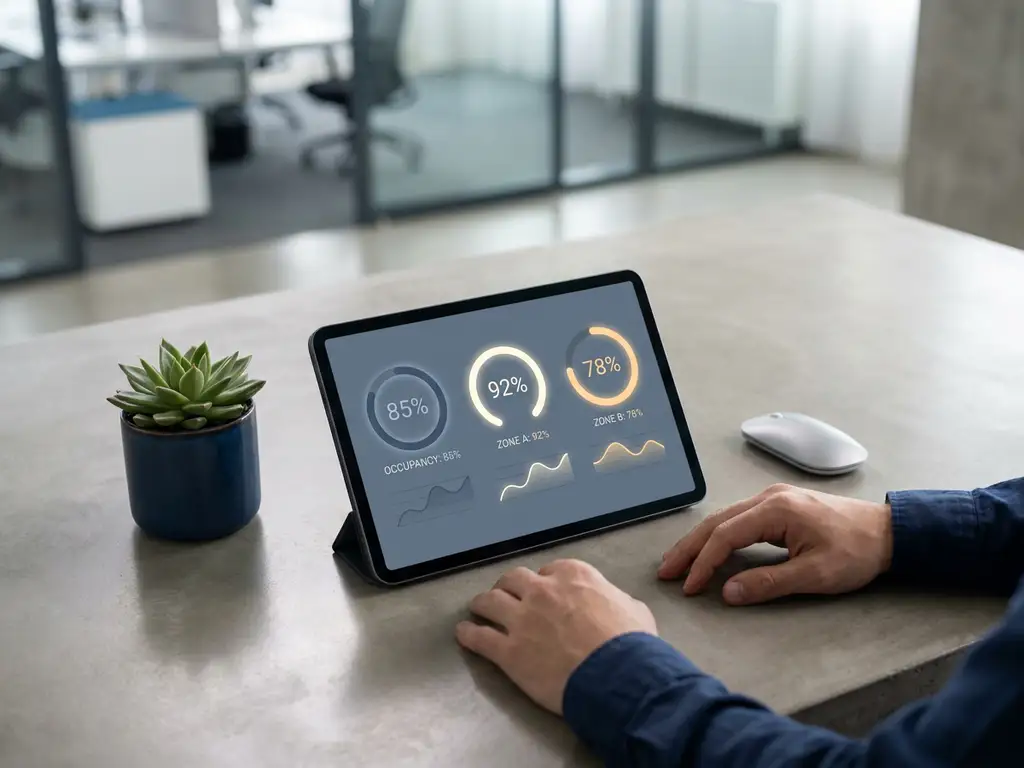
Facility managers can measure workplace culture effectiveness by combining space utilization data, employee feedback, behavioral patterns, and hybrid work metrics into a set of trackable KPIs. Culture is not invisible; it leaves a measurable footprint in how people use the office, how often they show up, and whether they feel the environment supports the way they work. The questions below unpack each dimension of that measurement in practical terms.
What metrics actually reflect workplace culture?
The metrics that most accurately reflect workplace culture are voluntary office attendance, collaboration space usage, no-show rates for booked rooms, cross-team interaction frequency, and employee net promoter scores. These indicators reveal whether people choose to engage with the office and with each other, which is the behavioral core of culture.
Hard metrics like desk occupancy rates and room booking frequency show whether the workplace is being used. But culture metrics go one layer deeper: they show how and why it is being used. A high desk occupancy rate paired with low collaboration space usage, for example, can signal a culture of isolated, heads-down work rather than genuine team engagement.
Key office culture metrics worth tracking include:
- Voluntary attendance rate – how often employees come in on days they are not required to
- Collaboration zone utilization – percentage of time informal meeting areas and project spaces are occupied
- Ghost meeting rate – the share of booked rooms that go unused without cancellation
- Repeat booking behavior – whether employees return to the same spaces and colleagues, suggesting stable team rituals
- Employee experience scores – structured pulse surveys tied to specific office touchpoints
Tracking these together gives facility managers a much richer picture of cultural health than any single data point can provide.
How does space utilization data reveal cultural problems?
Space utilization data reveals cultural problems by exposing the gap between how the office was designed to be used and how people actually use it. Persistent underuse of collaboration areas, clustering of occupancy on certain days only, or high no-show rates for booked rooms are all behavioral signals that point to underlying cultural friction.
When occupancy data shows that 70% of employees come in on Tuesday and Wednesday but the office sits at 15% capacity on Monday and Friday, that is not just a scheduling issue. It reflects a cultural norm around which days feel “worth” commuting for. Facility managers who only see this as a space efficiency problem miss the cultural insight it contains.
Similarly, a high ghost meeting rate, where rooms are booked but not checked in, suggests a culture where accountability for shared resources is low. That can cascade into frustration among employees who cannot find available space, which in turn discourages office attendance altogether. Space data, read through a cultural lens, becomes an early warning system for engagement problems before they show up in survey results.
What’s the difference between employee satisfaction and culture effectiveness?
Employee satisfaction measures how content people are with their current conditions, while culture effectiveness measures whether the shared behaviors, norms, and values of the organization are actually functioning as intended. Satisfaction is a snapshot of feeling; culture effectiveness is a measure of organizational behavior in action.
An employee can be satisfied with their salary and their manager while still operating in a culture that discourages collaboration, punishes risk-taking, or creates invisible barriers between departments. Conversely, a team going through a challenging period might score lower on satisfaction surveys but demonstrate strong cultural effectiveness through high trust, open communication, and shared accountability.
For facility managers specifically, this distinction matters because workplace design and management decisions affect culture effectiveness more directly than they affect satisfaction. A well-designed office with transparent booking systems, easy wayfinding, and reliable collaboration tools removes friction from cultural behaviors like spontaneous teaming, knowledge sharing, and cross-functional work. That is a culture effectiveness lever, not just a comfort improvement.
How can facility managers track hybrid work culture specifically?
Facility managers can track hybrid work culture by measuring the consistency of in-office behavior over time, the balance of solo versus collaborative space usage, and the degree to which the physical office is genuinely integrated into hybrid workflows rather than used as a fallback. The goal is to understand whether hybrid culture is working by design or by default.
Specific indicators for hybrid work culture measurement include:
- Attendance pattern consistency – are employees following team agreements about office days, or is presence unpredictable?
- Desk booking lead time – short lead times suggest reactive, unplanned office use; longer advance bookings suggest intentional hybrid planning
- Team co-location rate – how often members of the same team are physically present on the same days
- Meeting room technology usage – whether hybrid meetings are being supported with proper AV setups, indicating inclusive meeting culture
- Return visit frequency – whether employees who come in once tend to come back, which signals positive in-office experience
These metrics help distinguish between a hybrid culture that is genuinely working, where people make deliberate choices to collaborate in person, and one that is simply unmanaged flexibility with no shared norms.
Which tools do facility managers use to measure workplace culture?
Facility managers use a combination of workplace management platforms, occupancy sensors, employee pulse survey tools, and analytics dashboards to measure workplace culture. The most effective approach integrates data from physical space usage with direct employee feedback, rather than relying on either source alone.
Workplace management software is the foundation. Platforms that track desk bookings, room reservations, check-in behavior, and occupancy rates generate the behavioral data that makes culture visible at scale. Our Smart Office platform brings together booking data, sensor-based occupancy insights, and usage analytics in a single dashboard, giving facility managers the operational picture they need to connect space behavior with cultural outcomes.
Beyond the platform layer, effective culture measurement typically involves:
- Occupancy sensors – provide real-time and historical data on space usage without relying on manual check-ins
- Pulse survey tools – short, frequent surveys tied to specific office visits capture experience data while it is still fresh
- HR and engagement platforms – connect workplace data to broader people metrics like retention, absenteeism, and team performance
- Calendar and booking integrations – data from Microsoft 365 or Google Workspace reveals meeting patterns and collaboration rhythms
The key is connecting these sources so that behavioral data and experiential data can be read together, rather than in separate silos.
How often should workplace culture data be reviewed?
Workplace culture data should be reviewed on three timeframes: weekly for operational signals, monthly for trend analysis, and quarterly for strategic decisions. Each review cycle serves a different purpose and requires a different level of depth.
Weekly reviews of space utilization and booking data help facility managers catch immediate problems, such as a sudden spike in ghost meetings or an unexpected drop in attendance, before they become entrenched patterns. These reviews are operational and should be quick.
Monthly reviews allow teams to identify emerging trends across the data. Is collaboration space utilization growing or declining? Are certain teams showing stronger co-location patterns than others? Monthly analysis is where early cultural signals become visible.
Quarterly reviews are where workplace culture data connects to strategic decisions: whether to reconfigure space, adjust hybrid work policies, invest in new technology, or address specific team dynamics. This is also the right cadence for sharing findings with HR, operations leadership, and C-level stakeholders who need the data to make decisions about the broader employee experience.
The rhythm matters as much as the frequency. Culture data reviewed inconsistently or only when a problem becomes obvious loses its value as a proactive management tool. Building a regular review cadence into the facility management calendar turns culture measurement from a reactive exercise into a genuine strategic capability.
How GoBright helps you measure and improve workplace culture
Measuring workplace culture effectiveness requires reliable, real-time data about how your office is actually being used. That is exactly what we built GoBright to deliver. Our Smart Office platform combines desk and room booking, occupancy sensors, and analytics into a single unified system, giving facility managers the behavioral data they need to understand and actively shape office culture.
With GoBright, you can:
- Track occupancy rates, ghost meeting patterns, and collaboration space usage from one dashboard
- Monitor hybrid attendance trends and team co-location behavior over time
- Integrate seamlessly with Microsoft 365 and Google Workspace to connect booking data with existing workflows
- Use anonymized, GDPR-compliant data to make confident, evidence-based decisions about your workplace
- Scale insights across multiple locations without additional infrastructure investment
Culture is not something you can manage without data. If you want to move from guesswork to genuine insight, we are ready to show you how. Get in touch with our team and let us walk you through what GoBright can reveal about your workplace.
Frequently Asked Questions
How do I get started with measuring workplace culture if we have no existing data infrastructure?
Start with what you already have: desk booking logs, room reservation data, and calendar integrations from tools like Microsoft 365 or Google Workspace. Even basic booking data can reveal ghost meeting rates, attendance patterns, and collaboration space usage without any additional investment. From there, layer in a simple pulse survey to capture employee experience data, and you will have the foundation of a culture measurement system before committing to a full platform.
What is a healthy benchmark for ghost meeting rates, and when should I be concerned?
A ghost meeting rate below 10% is generally considered healthy, meaning 90% or more of booked rooms are actually used. Rates consistently above 20–25% are a strong signal of cultural friction around resource accountability and should prompt both a policy review and a closer look at whether the booking process itself creates unnecessary friction. If your ghost rate spikes suddenly rather than trending gradually, investigate whether a specific team, floor, or day of the week is driving the anomaly before drawing broader conclusions.
Can workplace culture metrics be gamed or skewed by employees who know they are being tracked?
Behavioral data is inherently harder to game than self-reported survey data, which is one of its key advantages. Employees can answer a satisfaction survey positively while disengaging in practice, but they cannot easily fake consistent voluntary attendance or genuine collaboration space usage over time. The best safeguard is to use anonymized, aggregated data rather than individual-level tracking, which both protects privacy and shifts the focus to team and organizational patterns rather than individual behavior.
How should facility managers present workplace culture data to leadership or HR to drive real decisions?
Frame culture data in terms of business outcomes rather than operational metrics alone. Instead of reporting that collaboration space utilization dropped 15%, connect it to what that likely means: reduced cross-team interaction, potential impact on innovation or onboarding, and a risk signal for retention. Presenting data in a quarterly narrative format, with trend lines and a clear so-what for each metric, makes it far more actionable for HR and C-suite stakeholders than a raw dashboard export.
What is the biggest mistake facility managers make when trying to measure workplace culture?
The most common mistake is treating space utilization data as the whole picture rather than as one layer of a multi-source measurement system. Occupancy rates alone can look healthy while collaboration quality, psychological safety, and cross-team connectivity are quietly deteriorating. Effective culture measurement always triangulates between behavioral data, employee experience feedback, and HR metrics like retention and absenteeism to avoid drawing misleading conclusions from any single source.
How long does it typically take to see meaningful cultural trends in the data?
Most cultural trends become statistically meaningful after 8–12 weeks of consistent data collection, though some signals, like a sudden spike in ghost meetings or a sharp attendance drop, can appear within a single weekly review cycle. Seasonal effects, return-to-office policy changes, and major organizational events can all create short-term noise, so it is important to establish a baseline period of at least one full quarter before drawing strategic conclusions. Patience with the data is part of the discipline.
Should smaller organizations or single-site offices bother with formal culture measurement, or is it only relevant at scale?
Formal culture measurement is valuable at any size, but the approach should be proportionate. A single-site office with fewer than 100 employees does not need enterprise-grade sensor infrastructure; a combination of a basic booking tool, monthly pulse surveys, and a structured quarterly review can deliver meaningful cultural insight at low cost. In fact, smaller organizations often see faster impact from culture data because decision-makers are closer to the findings and can act on them without lengthy approval cycles.