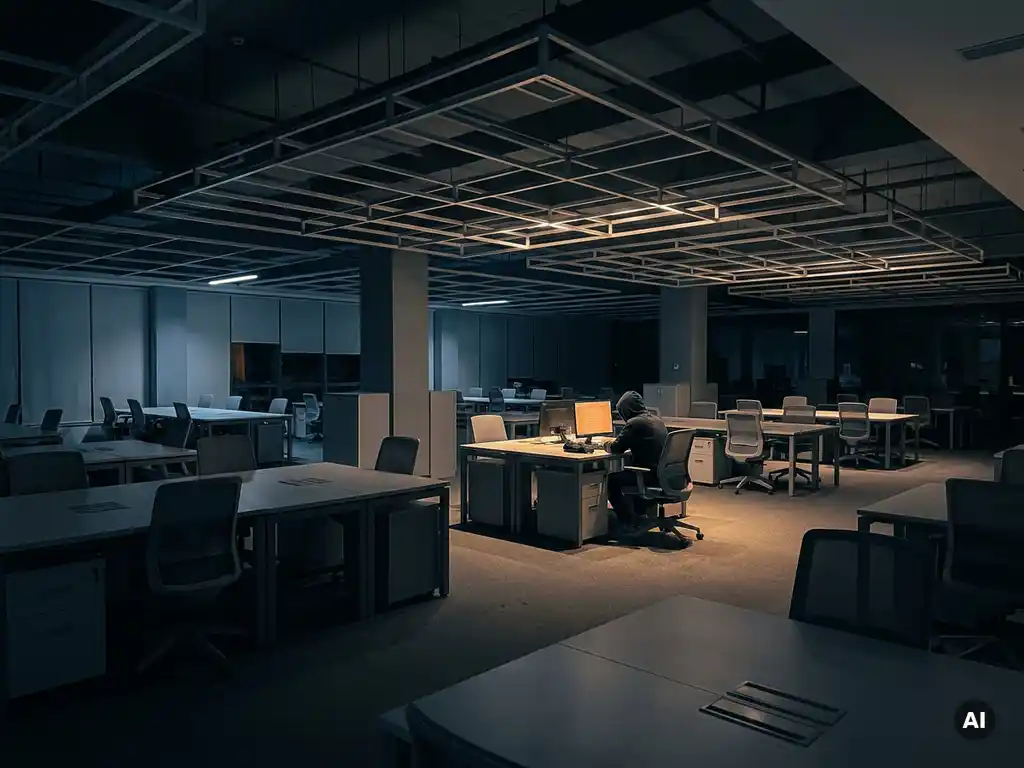
Poor space utilization directly reduces workplace productivity by creating friction in how employees work, collaborate, and plan their time. When office space is inefficiently managed, employees waste time searching for desks or meeting rooms, collaboration becomes harder to coordinate, and the office itself starts to feel like an obstacle rather than an asset. The sections below unpack the specific signs, costs, and practical fixes behind this challenge.
What are the signs of poor space utilization in an office?
The clearest signs of poor space utilization are a mismatch between available space and actual usage: rooms that sit empty while employees struggle to find a quiet spot, or entire floors that feel deserted on certain days while others feel overcrowded. These patterns are visible even without data, but they are often accepted as normal rather than recognized as fixable problems.
Common indicators include:
- Meeting rooms booked for hours but visibly empty for most of that time
- Employees working in corridors, cafeterias, or informal spaces because no desk is available
- Certain areas of the office consistently overcrowded while others go unused
- No clear picture of how many people are actually in the building on any given day
- Facilities teams making layout decisions based on assumptions rather than occupancy data
These signs tend to compound over time. A poorly utilized office does not just waste space. It signals to employees that the workplace was not designed with their actual working patterns in mind, which quietly erodes engagement and motivation.
How does poor space utilization affect employee productivity?
Poor space utilization affects employee productivity by introducing daily friction into how people work. When employees cannot find a suitable workspace quickly, they lose time, focus, and the mental energy needed for meaningful work. Over a week, these small disruptions add up to a measurable drag on output and morale.
The impact shows up in several concrete ways. Employees who arrive at the office without a guaranteed desk spend time scanning for available spots rather than settling into their work. Teams trying to book a room for a spontaneous discussion often give up and default to a scattered remote call instead, which weakens collaboration. When people cannot see who else is in the office on a given day, they lose one of the main reasons to come in at all.
There is also a psychological dimension. Uncertainty about whether the office will meet basic needs (a desk, a quiet space, a room for a meeting) makes employees less likely to commit to coming in. That hesitation undermines the consistency that hybrid work models depend on to function well. Productivity in a hybrid environment is not just about individual output; it requires enough predictability for teams to coordinate effectively, and poor space management erodes exactly that.
What is the financial cost of underutilized office space?
Underutilized office space is one of the most significant and least visible costs in a typical organization’s budget. Real estate is usually the second-largest operating expense after salaries, and when large portions of that space sit empty for much of the working week, organizations are effectively paying for capacity they are not using.
The financial impact extends beyond the rent itself. Energy costs scale with the size of the space being heated, cooled, and lit, not with actual occupancy. Cleaning, maintenance, and facility management costs follow the same logic. Organizations managing multiple locations face this challenge at scale, where even a modest reduction in average occupancy across several offices translates into substantial unnecessary expenditure.
Beyond direct costs, underutilized space also represents a missed opportunity. Organizations that understand their actual space needs can make smarter decisions: consolidating floors, redesigning layouts to match how people actually work, or renegotiating leases with confidence. Without reliable occupancy data, those decisions are guesswork, and guesswork in real estate is expensive.
Why do ghost meetings and no-shows make space problems worse?
Ghost meetings and no-shows make space problems significantly worse because they create the illusion of full occupancy while rooms remain physically empty. A meeting room that appears booked in the calendar system is invisible to anyone else who needs it, even if the original booking was never used. This is one of the most common and frustrating sources of wasted office space.
Ghost meetings occur when rooms are booked but the meeting is cancelled informally: the calendar invite disappears, but the room booking remains. No-shows happen when attendees simply do not turn up and no one releases the room. In both cases, the room is locked out of circulation for its entire booked duration, often for meetings that were scheduled to last an hour or more.
The downstream effect on workplace productivity is real. Employees who cannot find a room for a legitimate meeting are forced to improvise, which disrupts focus and wastes time. Teams that repeatedly experience this start to over-book rooms defensively, reserving extra time or multiple rooms to guarantee availability, which compounds the original problem. Without a system that automatically releases unused bookings, the cycle continues and the perceived shortage of space grows worse even when physical capacity has not changed.
How can workplace analytics help fix space utilization issues?
Workplace analytics help fix space utilization issues by replacing guesswork with evidence. Instead of relying on assumptions about how the office is used, facilities managers and leadership teams gain access to real occupancy data: which spaces are used, when, by how many people, and for how long. That data makes it possible to identify problems precisely and act on them with confidence.
With the right analytics in place, organizations can answer questions that were previously unanswerable:
- Which meeting rooms are consistently over-booked and which are rarely touched?
- What are the actual peak occupancy days and times across different floors or locations?
- How does space usage shift across the week in a hybrid work model?
- Are there patterns in no-shows or ghost meetings that suggest a process problem?
- Is the current office footprint proportionate to actual demand?
These insights support better decisions at every level. Facility managers can redesign layouts to reflect real working patterns. Operations teams can set policies around booking behavior that reduce waste. Leadership can make evidence-based arguments for real estate decisions rather than relying on gut feel. Workplace analytics transforms space management from a reactive task into a strategic capability.
What tools are most effective for improving office space utilization?
The most effective tools for improving office space utilization combine real-time booking systems with occupancy sensors and analytics dashboards. No single tool solves the problem in isolation. The biggest gains come from integrating booking behavior with actual usage data, so that what employees reserve and what they actually use can be compared and acted upon.
The core toolkit typically includes:
- Desk booking software that allows employees to reserve workspaces in advance, reducing the daily scramble and giving facilities teams visibility into demand patterns
- Room booking systems with automatic release features that free up spaces when no-shows are detected, preventing ghost meetings from locking out capacity
- Occupancy sensors that capture real-time data on how spaces are being used, independent of what the booking system shows
- Analytics dashboards that surface trends in space usage, occupancy rates, and booking behavior across days, floors, and locations
- Integrations with existing tools like Microsoft 365 or Google Workspace, so employees can book spaces without leaving the platforms they already use
The most important criterion when choosing tools is integration. Disconnected systems create data silos and add IT complexity. A unified platform that syncs bookings, sensor data, and analytics in one place gives a far clearer picture of how the office is actually being used and makes it much easier to act on what that picture reveals. You can explore the full range of workplace management solutions to understand what an integrated approach looks like in practice.
How GoBright helps you get more from your office space
We built GoBright’s Smart Office platform specifically for organizations dealing with exactly these challenges. Whether it is ghost meetings blocking rooms, employees struggling to find colleagues, or leadership lacking the data to make confident real estate decisions, our platform addresses each problem through a single connected system.
Here is what that means in practice:
- Desk and room booking with automatic no-show detection and room release, so space is never locked out unnecessarily
- Occupancy sensors and analytics dashboards that give facility managers real-time and historical insight into how every part of the office is used
- Team Booking and Find My Colleague features that make it easy to coordinate in-office days and reduce the uncertainty that keeps employees away
- Full integration with Microsoft Teams, Outlook, and Google Workspace, so booking happens inside the tools your employees already use
- ISO 27001 certification and GDPR compliance, with European data hosting, so security and privacy are never a concern
- Licensing per desk or room rather than per user, making the platform genuinely cost-efficient as your organization scales
If poor space utilization is costing your organization time, money, or employee engagement, we would be glad to show you what a smarter approach looks like. Get in touch with us and let’s talk through what GoBright can do for your workplace.