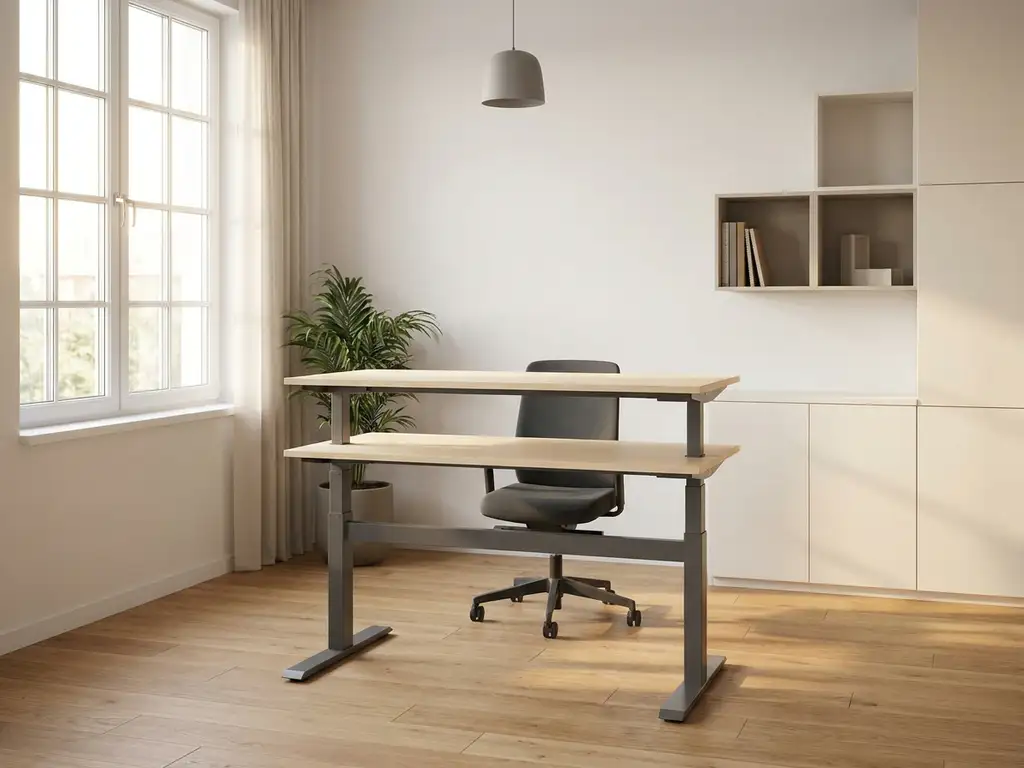
Sit-stand desks play a meaningful role in workplace culture by signaling that an organization genuinely cares about employee health, comfort, and autonomy. They shift the office from a static, one-size-fits-all environment toward one that adapts to how people actually work. For hybrid and flexible organizations in particular, height-adjustable desks have become a visible, practical expression of a people-first culture.
The questions below unpack the specific ways sit-stand desks affect wellbeing, productivity, and office design, and when they are worth the investment.
Do sit-stand desks actually improve employee wellbeing?
Yes, sit-stand desks do improve employee wellbeing, particularly by reducing the physical discomfort associated with prolonged sitting. Research in occupational health consistently links extended sedentary work to back pain, neck tension, and fatigue. Height-adjustable desks give employees the ability to alternate postures throughout the day, which reduces musculoskeletal strain and helps maintain energy levels.
Beyond the physical benefits, there is a psychological dimension worth noting. When employees have control over their immediate work environment, including something as simple as desk height, they tend to report higher job satisfaction. The desk becomes a small but tangible expression of trust and autonomy. In office wellbeing strategies, that sense of agency matters more than most employers expect.
It is worth being realistic, though. A sit-stand desk only delivers its full benefit when employees actually use the standing function. Without a culture that encourages movement breaks and without basic ergonomic awareness, the desks can become expensive furniture that stays in the sitting position all day.
How do height-adjustable desks affect productivity at work?
Height-adjustable desks can support productivity by reducing physical discomfort that would otherwise interrupt focus. When employees are not distracted by back pain or fatigue, sustained concentration becomes easier. Alternating between sitting and standing also helps maintain alertness during longer work sessions, particularly in the afternoon when energy typically dips.
The productivity effect is not dramatic or universal, but it is consistent in a specific way: ergonomic office setups reduce the micro-interruptions caused by physical discomfort. Fewer trips to stretch, fewer complaints, and less time lost to discomfort-related distraction all contribute to a more focused working day.
For knowledge workers who spend most of their day at a screen, the cumulative benefit over weeks and months is more significant than any single day’s improvement. Think of it as removing friction rather than adding a performance boost.
Why are sit-stand desks becoming standard in hybrid offices?
Sit-stand desks are becoming standard in hybrid offices because flexible working demands flexible furniture. In a hybrid workplace, desks are shared rather than assigned. Different employees use the same workstation on different days, and they bring different height preferences, working styles, and physical needs. A fixed-height desk simply cannot accommodate that range of users effectively.
There are several reasons this shift is accelerating in 2026:
- Hot-desking and activity-based working are now the norm in many organizations, making adaptable furniture a practical necessity rather than a luxury.
- Employee expectations around workplace quality have risen significantly since the widespread adoption of hybrid models.
- Facility managers are under pressure to make the office compelling enough to draw employees in voluntarily, and ergonomic comfort is one of the most direct ways to do that.
- Height-adjustable desks pair naturally with smart office technology, including desk booking systems that can store personal height preferences.
In short, the hybrid office has made sit-stand desks a functional standard rather than a premium add-on.
What’s the difference between sit-stand desks and regular ergonomic desks?
The key distinction is adjustability. A regular ergonomic desk is designed with correct working height and posture in mind, but it is typically fixed at a single position. A sit-stand desk, also called a height-adjustable desk, allows the entire surface to move up and down so the user can alternate between sitting and standing throughout the day.
Both types address ergonomic office principles, but they do so differently:
- Fixed ergonomic desks are optimized for a single correct seated posture. They work well for dedicated workstations where one person uses the desk consistently and has set it up to their own proportions.
- Sit-stand desks add postural variety on top of correct ergonomics. They accommodate multiple users of different heights and allow the same person to change position during the day.
- Smart sit-stand desks take this further by storing individual height presets, so a returning employee can restore their preferred position instantly, a particularly valuable feature in hot-desking environments.
For shared workspaces, sit-stand desks are the more practical choice. For permanently assigned desks, a high-quality fixed ergonomic setup may be sufficient, depending on the employee’s needs.
How does desk booking software work with sit-stand desks?
Desk booking software integrates with sit-stand desks by linking a user’s profile to their preferred desk height settings. When an employee books a specific desk through a booking platform, the system can automatically adjust the desk to their saved height preference when they arrive and check in. This removes the need to manually adjust the desk each time, which is a real convenience in busy shared offices.
Beyond personal preferences, desk booking software adds broader value to sit-stand desk management:
- Employees can filter available desks by type, including height-adjustable options, so they always find the right workstation for their needs.
- Occupancy data from desk sensors helps facility managers understand which sit-stand desks are most used, informing future investment decisions.
- Booking systems prevent the frustration of arriving at the office only to find that all ergonomic desks are taken.
This kind of integration turns sit-stand desks from standalone furniture into connected components of a broader flexible workplace strategy. The technology handles the logistics, so employees can focus on their work.
Should every office invest in sit-stand desks?
Not every office needs to invest in sit-stand desks immediately, but for hybrid and activity-based working environments, they are a sound investment. The strongest case exists where desks are shared, where employee wellbeing is a strategic priority, and where the organization wants the office to feel genuinely better than working from home.
Smaller or fully assigned-desk offices with stable, long-term employees may find that high-quality fixed ergonomic setups serve them just as well at a lower cost. The decision should be driven by how the office is actually used, not by trend alone.
A few questions worth asking before investing:
- Are desks shared between multiple employees on different days?
- Do employees report physical discomfort or fatigue as a recurring issue?
- Is the office competing with home working for employee attendance?
- Does the organization have a desk booking system that can leverage height memory features?
If the answer to most of these is yes, sit-stand desks are likely to deliver a meaningful return, not just in health outcomes, but in how employees perceive and value the office environment.
How GoBright supports smarter desk management in hybrid offices
We help organizations get the most out of their office investment, including sit-stand desks, through our integrated workplace management platform. Rather than managing desks as isolated pieces of furniture, our approach connects booking, presence, and analytics into a single system.
Here is what that looks like in practice:
- Personal desk preferences: Employees can save their sit-stand desk height settings in their profile, which the system applies automatically at check-in.
- Smart desk booking: Staff can filter and reserve height-adjustable desks in advance via the GoBright app, Microsoft Teams, or Outlook, ensuring they always have the right workstation available.
- Occupancy analytics: Sensor data reveals which desks and desk types are most used, giving facility managers the insight they need to optimize their ergonomic office investment.
- Find My Colleague: Employees can see where colleagues are sitting, making it easier to book nearby and collaborate in person.
- GDPR-compliant and ISO 27001 certified: All data is processed securely on European servers, meeting the highest standards for enterprise data protection.
Sit-stand desks are a great starting point for a healthier, more flexible office. Combined with the right workplace technology, they become part of a genuinely smart working environment. Want to see how we can support your hybrid office setup? Get in touch with our team and we will be happy to show you what is possible.
Frequently Asked Questions
How often should employees actually switch between sitting and standing throughout the day?
Most occupational health guidelines recommend alternating between sitting and standing every 30 to 60 minutes, rather than standing for long uninterrupted periods. A practical starting point is the 20-8-2 rule: 20 minutes sitting, 8 minutes standing, and 2 minutes moving or stretching per half-hour cycle. The key is building the habit gradually, as employees who are new to sit-stand desks often find extended standing uncomfortable at first and need a few weeks to adjust.
What common mistakes do organizations make when rolling out sit-stand desks?
The most common mistake is investing in the hardware without investing in adoption. Simply installing sit-stand desks does not guarantee employees will use the standing function, especially if no guidance or encouragement is provided. Organizations also frequently overlook complementary ergonomic elements such as anti-fatigue mats, monitor arms, and keyboard positioning, all of which are essential for standing posture to be genuinely comfortable and sustainable.
Can sit-stand desks accommodate employees with specific physical conditions or disabilities?
Yes, and this is one of their most underappreciated strengths. Height-adjustable desks are particularly valuable for employees with chronic back conditions, mobility limitations, or conditions that make prolonged sitting painful, such as sciatica or hip problems. They also accommodate wheelchair users when set to lower positions. When evaluating sit-stand desks for accessibility purposes, check the minimum and maximum height range of the model, as these vary significantly between manufacturers.
How do you calculate whether sit-stand desks are worth the cost for your specific office?
A straightforward way to assess ROI is to weigh the desk cost against the measurable costs of poor ergonomics, including absenteeism related to musculoskeletal complaints, reduced productivity from discomfort, and employee turnover influenced by workplace quality. For hybrid offices, factor in utilization rates: a sit-stand desk used by three different employees per week delivers three times the value of an assigned fixed desk. Pairing desks with occupancy analytics, as provided by platforms like GoBright, makes it possible to track actual usage and validate the investment over time.
What should we look for when choosing a sit-stand desk for a shared hot-desking environment?
For shared environments, prioritize electric height adjustment over manual cranks, as speed and ease of use directly affect whether employees bother adjusting the desk at all. Look for models with programmable height presets, a height range that covers the full spectrum of your workforce, and a stable frame at maximum height to avoid wobble during standing use. Compatibility with your desk booking system for automatic height recall is a significant advantage worth confirming with both the desk manufacturer and your workplace technology provider before purchasing.
Will employees actually use sit-stand desks differently in a hybrid office compared to a traditional assigned-desk setup?
Yes, the usage pattern tends to differ. In assigned-desk offices, employees often personalize their desk height once and rarely change it, effectively treating a sit-stand desk like a fixed one. In hot-desking environments, the adjustment happens more naturally because employees are already reconfiguring the space each time they arrive. This makes the automatic height recall feature particularly impactful in hybrid offices, as it removes the friction that would otherwise discourage adjustment.
How can facility managers encourage employees to actually use the standing function of their desks?
The most effective approaches combine awareness with environmental nudges. Brief onboarding sessions that explain the health rationale and demonstrate how to use the desk take less than ten minutes and significantly improve adoption rates. Some organizations use desk booking apps or wellness platforms to send gentle reminders to stand during the day. Creating a visible culture where managers and team leads are seen using the standing function also normalizes the behavior far more effectively than any policy document.