Indoor air quality directly impacts employee concentration by affecting oxygen levels, cognitive function, and overall brain performance. Poor air quality reduces focus, decision-making abilities, and productivity by up to 15%, while optimal conditions with proper ventilation, humidity control, and pollutant management create environments where employees can maintain sustained attention and perform complex tasks effectively.
Why is stuffy office air costing you your best talent?
That heavy, stagnant feeling in your office isn’t just uncomfortable—it’s actively driving away top performers who recognize the connection between their environment and their ability to do exceptional work. When carbon dioxide levels climb above 1,000 parts per million, cognitive performance drops measurably, affecting everything from strategic thinking to creative problem-solving. Your high achievers notice when they struggle to concentrate during afternoon meetings or feel mentally foggy by 3 PM, and they start questioning whether your workplace truly supports their success. The solution lies in implementing smart office technology that monitors air quality in real time and automatically adjusts ventilation systems to maintain optimal conditions for peak performance.
What does employee fatigue signal about your workplace wellbeing strategies?
When employees consistently report feeling tired or unfocused at work, it often indicates that your current workplace wellbeing strategies aren’t addressing fundamental environmental factors that affect energy and concentration. Poor indoor air quality creates a cascade of physiological stress responses—reduced oxygen to the brain, increased CO2 exposure, and exposure to volatile organic compounds—that manifest as the very fatigue and distraction you’re seeing. Rather than simply offering wellness programs or ergonomic furniture, you need to measure and optimize the invisible environmental factors that directly impact how employees feel and perform. Smart office sensors can provide the data you need to identify air quality issues and create targeted solutions that address the root cause of workplace fatigue.
What is indoor air quality and why does it affect concentration?
Indoor air quality encompasses the cleanliness and characteristics of air within buildings, including factors like carbon dioxide levels, humidity, temperature, and the presence of pollutants or allergens. This directly affects concentration because your brain requires approximately 20% of your body’s oxygen supply to function optimally. When air quality deteriorates, several physiological processes impact cognitive performance.
Carbon dioxide buildup is particularly problematic in office environments. As CO2 levels rise above 800-1,000 parts per million, employees experience decreased alertness, slower reaction times, and difficulty maintaining focus on complex tasks. The brain interprets elevated CO2 as a signal to conserve energy, triggering drowsiness and reduced mental acuity.
Temperature and humidity also play crucial roles in concentration. Environments that are too warm or humid can cause discomfort and distraction, while overly dry conditions can lead to respiratory irritation and reduced comfort. The optimal range for cognitive performance typically falls between 68-72°F with humidity levels between 40-60%.
Smart office technology enables organizations to monitor these factors continuously, providing facility managers with real-time data to maintain optimal conditions for employee wellbeing in the workplace.
How does poor air quality reduce employee focus and productivity?
Poor air quality creates a domino effect that systematically undermines employee focus and productivity through multiple biological and psychological pathways. When indoor air contains elevated levels of carbon dioxide, volatile organic compounds, or insufficient fresh air circulation, employees experience measurable declines in cognitive function that compound throughout the workday.
The most immediate impact occurs when CO2 concentrations exceed 1,000 parts per million. At these levels, employees show reduced performance on tasks requiring sustained attention, strategic thinking, and information processing. Decision-making becomes slower and less accurate, while creative problem-solving abilities decline noticeably. These effects intensify in meeting rooms where multiple people are present and ventilation may be inadequate.
Pollutants and allergens create additional challenges by triggering physical discomfort that diverts mental resources away from work tasks. Employees may experience headaches, eye irritation, or respiratory symptoms that require conscious effort to ignore, reducing the mental capacity available for focused work. This constant low-level distraction prevents employees from entering flow states where their most productive work occurs.
The psychological impact compounds these physical effects. When employees feel uncomfortable or notice air quality issues, stress levels increase and job satisfaction decreases. This creates a negative feedback loop where poor environmental conditions lead to reduced engagement, which further impacts productivity and workplace wellbeing strategies.
Modern hybrid work employee wellbeing initiatives must address these environmental factors to support optimal performance when employees choose to work in the office.
What are the main air quality factors that impact workplace concentration?
Several key environmental factors directly influence how well employees can concentrate and maintain peak cognitive performance throughout their workday. Understanding these factors enables organizations to create targeted workplace wellbeing strategies that address the root causes of distraction and mental fatigue.
Carbon dioxide concentration serves as the primary indicator of air quality in occupied spaces. Levels below 800 ppm support optimal cognitive function, while concentrations above 1,000 ppm begin to impair decision-making and sustained attention. In conference rooms and open office areas, CO2 can quickly accumulate without proper ventilation, creating zones where concentration becomes increasingly difficult.
Volatile organic compounds (VOCs) from office furniture, cleaning products, and building materials can cause headaches, drowsiness, and difficulty focusing. These chemicals are particularly problematic in newer buildings or recently renovated spaces where off-gassing occurs at higher rates.
Temperature regulation significantly affects cognitive performance, with the optimal range for most office work falling between 68-72°F. Temperatures outside this range force the body to expend energy on thermoregulation, leaving fewer resources available for mental tasks.
Humidity levels impact both comfort and health, with the ideal range between 40-60% relative humidity. Low humidity can cause respiratory irritation and static electricity issues, while high humidity promotes mold growth and creates a stuffy atmosphere that impairs concentration.
Air circulation and ventilation ensure a fresh oxygen supply and prevent the buildup of pollutants. Stagnant air creates pockets of poor air quality that employees instinctively avoid, limiting their workspace options and potentially forcing them into less productive areas.
Smart office management systems can monitor all these factors simultaneously, providing facility teams with comprehensive data to maintain optimal conditions for employee performance.
How can you monitor and measure office air quality effectively?
Effective air quality monitoring requires a systematic approach that combines strategic sensor placement, continuous data collection, and actionable insights to maintain optimal workplace conditions. Modern smart office technology makes this process both comprehensive and manageable for facility teams.
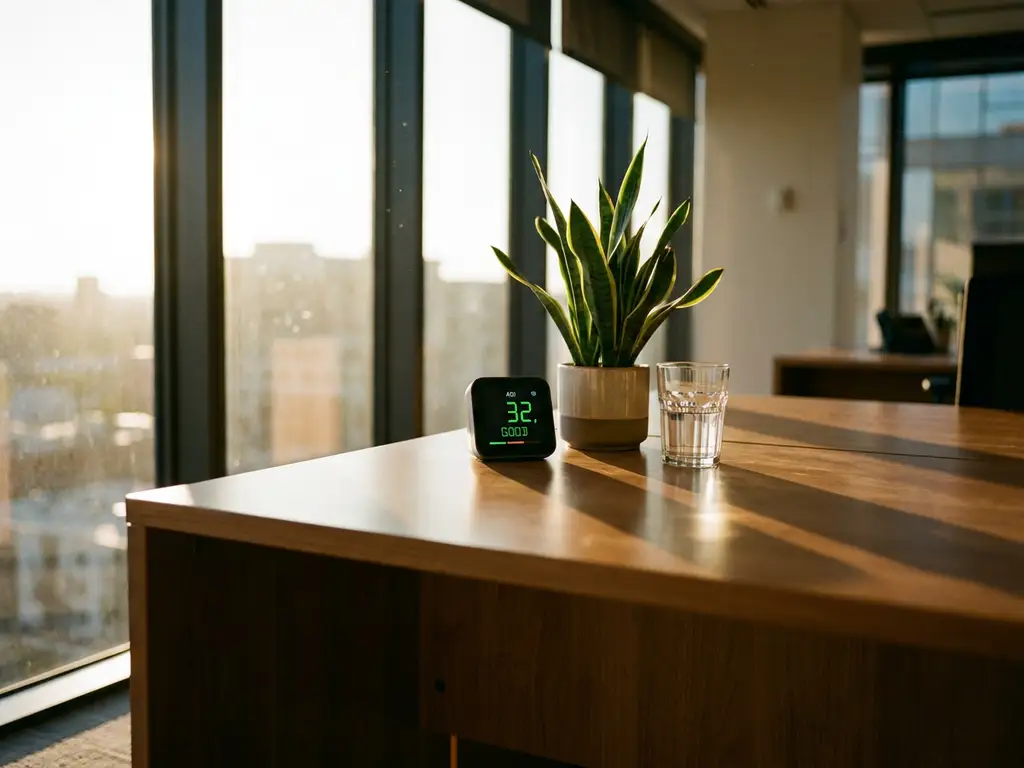
Smart office sensors provide the foundation for accurate air quality measurement. These devices should monitor multiple parameters simultaneously, including CO2 levels, temperature, humidity, and VOC concentrations. Occupancy sensors complement air quality monitoring by correlating environmental changes with space usage patterns, helping identify when and where air quality issues occur.
Strategic placement ensures comprehensive coverage across different work environments. Sensors should be positioned in high-occupancy areas like open office spaces, conference rooms, and collaboration zones where air quality impacts are most significant. We recommend placing sensors at breathing height (4-6 feet) and away from direct airflow from HVAC systems to capture accurate readings of the air employees actually breathe.
Real-time data integration with smart office software enables immediate responses to air quality changes. When sensors detect declining conditions, automated systems can trigger ventilation adjustments, alert facility managers, or even recommend workspace changes to employees through mobile apps.
Baseline establishment and trending help identify patterns and predict potential issues before they impact employee performance. By collecting data over time, organizations can understand how different factors—such as occupancy levels, weather conditions, or building systems—influence air quality in specific areas.
Integration with existing systems maximizes the value of air quality data by connecting it with HVAC controls, space booking systems, and workplace analytics platforms. This creates a comprehensive smart office management ecosystem where environmental conditions automatically adjust based on real-time needs and usage patterns through seamless integrations.
What workplace solutions improve air quality for better employee performance?
Creating optimal air quality for enhanced employee performance requires a combination of technological solutions, strategic space management, and proactive maintenance practices that work together to maintain consistently healthy indoor environments.
Automated ventilation systems represent the most effective long-term solution for maintaining optimal air quality. These systems use real-time data from smart office sensors to adjust fresh air intake, circulation rates, and filtration based on actual occupancy and air quality measurements rather than preset schedules. When integrated with occupancy sensors, ventilation systems can anticipate needs and pre-condition spaces before employees arrive.
Smart space allocation helps prevent air quality issues by distributing occupancy more effectively across available workspace. Desk booking systems that display real-time air quality data enable employees to choose workspaces with optimal conditions, while also providing facility managers with usage patterns that inform ventilation strategies.
Air purification technology addresses specific pollutants that ventilation alone cannot eliminate. High-efficiency particulate air (HEPA) filters and UV-C sanitization systems can be particularly effective in spaces with limited natural ventilation or high occupancy density.
Plant-based solutions provide natural air purification while enhancing the aesthetic appeal of workspaces. Certain plants effectively remove common office pollutants like formaldehyde and benzene, contributing to both air quality improvement and employee wellbeing in the workplace.
Workplace analytics and optimization enable continuous improvement of air quality management strategies. By analyzing patterns in air quality data alongside productivity metrics and employee feedback, organizations can identify the most effective interventions and optimize their hybrid work employee wellbeing initiatives.
Employee awareness and empowerment create a collaborative approach to air quality management. Digital signage can display real-time air quality information, while mobile apps allow employees to report issues or request adjustments to their immediate environment. This transparency builds trust and enables faster responses to emerging air quality concerns.
The most successful implementations combine multiple products within an integrated smart office technology platform that automatically coordinates responses across different systems to maintain optimal conditions for peak employee performance. For organizations looking to implement comprehensive air quality solutions, contact our team to explore how these technologies can transform your workplace environment and support your commitment to employee wellbeing.
How GoBright helps with indoor air quality monitoring
GoBright provides comprehensive smart office solutions that transform how organizations monitor and optimize indoor air quality for enhanced employee concentration and productivity. Our integrated platform offers:
• Real-time environmental sensors that continuously track CO2 levels, temperature, humidity, and air quality metrics across all workspace areas
• Automated HVAC integration that adjusts ventilation systems based on actual occupancy and air quality data rather than fixed schedules
• Intelligent space allocation through desk booking systems that display air quality information, enabling employees to choose optimal work environments
• Predictive analytics that identify air quality patterns and automatically trigger preventive measures before conditions impact employee performance
• Mobile notifications that alert facility managers to air quality issues and provide actionable recommendations for immediate resolution
Ready to create a healthier, more productive workplace environment? Contact GoBright today to discover how our smart office technology can optimize your indoor air quality and support peak employee performance through data-driven environmental management.