Customer Case Thomas More
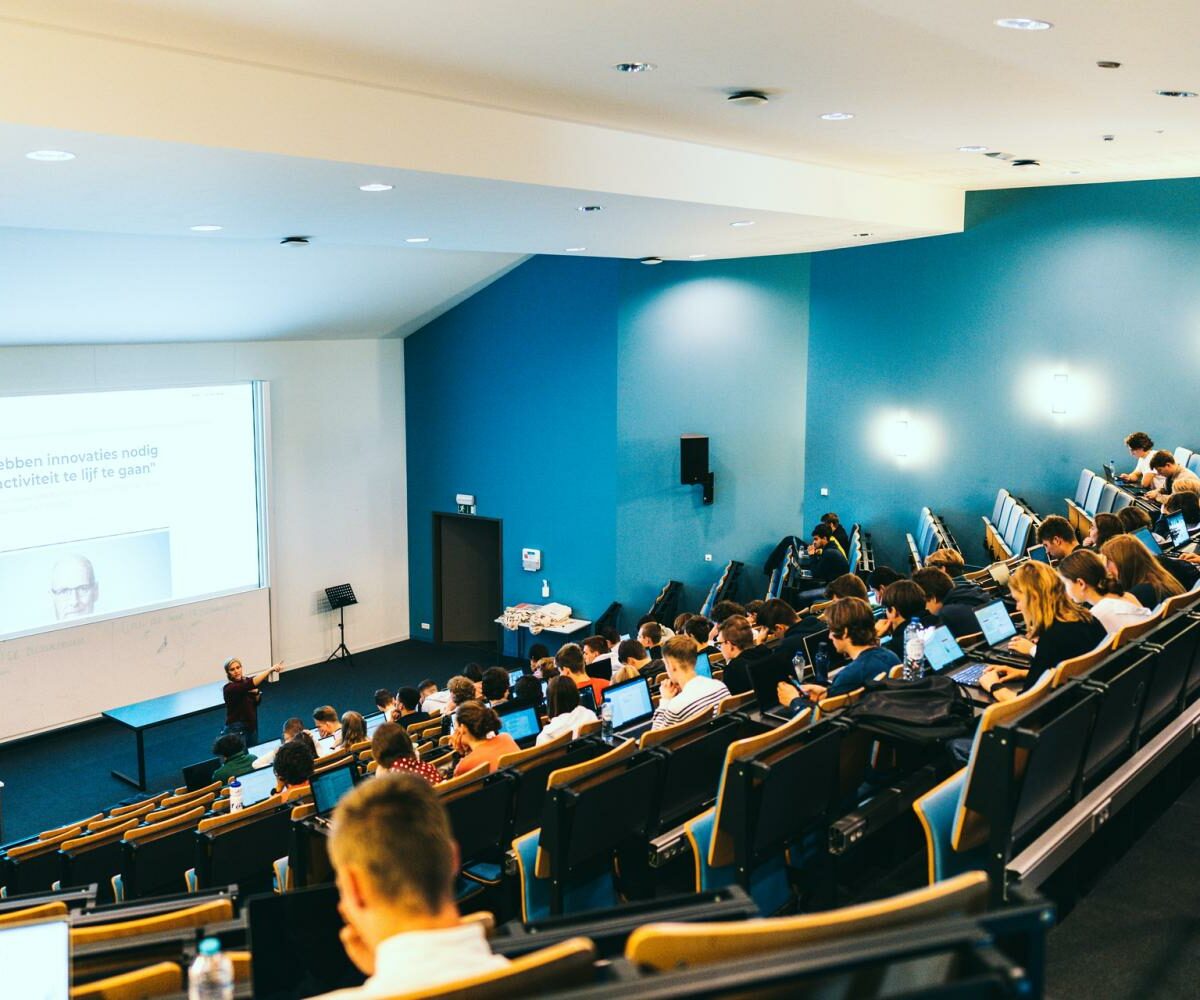
Comparing real occupancy with the timetable at Thomas More. Lecture halls booked to capacity on paper, but often under a quarter full in practice: that was the gap Thomas More set out to close.
- Occupancy Insights: Real-time and historical WiFi-based utilisation data across 26 buildings in 7 cities.
- Automated reporting: Actual usage compared against the timetable automatically, every night.
- Trend analysis: Short-, medium- and long-term usage trends tracked across 60 different programmes.
The challenge
Thomas More faced a problem familiar to many education institutions: not every enrolled student actually shows up to class. At the same time, there’s growing awareness that money spent on buildings that are only partially used could be better spent on education itself. The planning department knew attendance ran lower than enrolment figures suggested, but always had to plan with a wide margin to be safe. The result: lecture halls that looked fully booked on paper, but were often still under a quarter full in practice.

The solution
Four years ago, Kenny Vercauteren, Head of Planning at Thomas More, wanted to compare the timetable against the real, realised utilisation of classrooms and lecture halls. To start, a one-year pilot ran at Campus Geel, to establish whether WiFi-based occupancy data was accurate enough to be reliably compared against the schedule. Once that WiFi occupancy measurement proved sufficiently accurate, GoBright built a standard application to fully automate that timetable comparison.
Want to discuss how a smart workplace solution could help your workplace?
The result
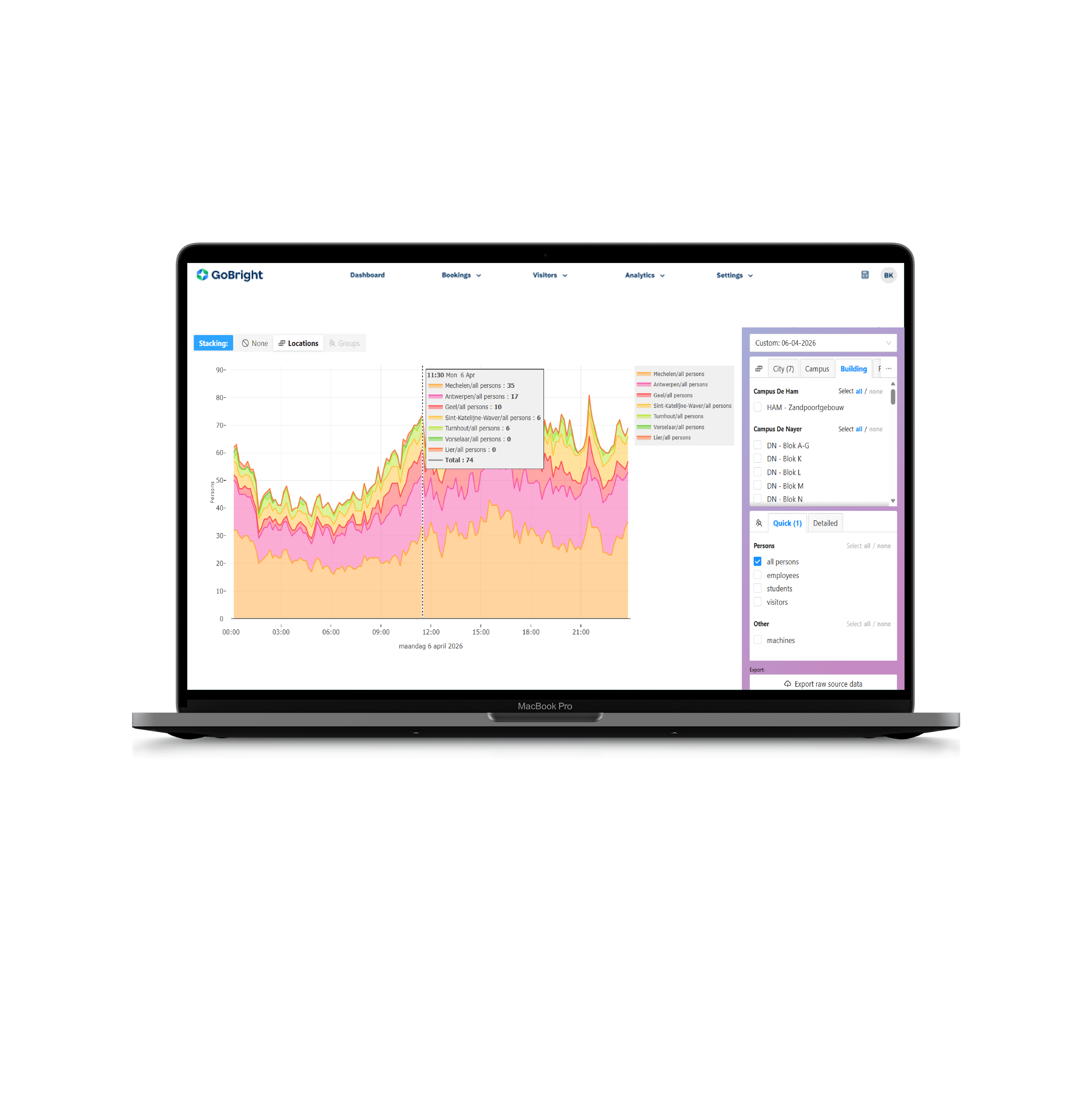
Thanks to GoBright’s WiFi-based occupancy measurement, Thomas More now has both historical and real-time insight into how its 26 buildings across 7 cities are used. This occupancy data is automatically compared against the timetable every night. That gives the planning department visibility into short-, medium- and long-term usage trends across the 60 different programmes Thomas More offers. After three years of WiFi occupancy measurement, it has also become clear how strongly student numbers per programme have developed, both upward and downward.
let’s make your workplace
smarter, together
Reach out to Chris
our CCO

Get inspired, read our latest cases
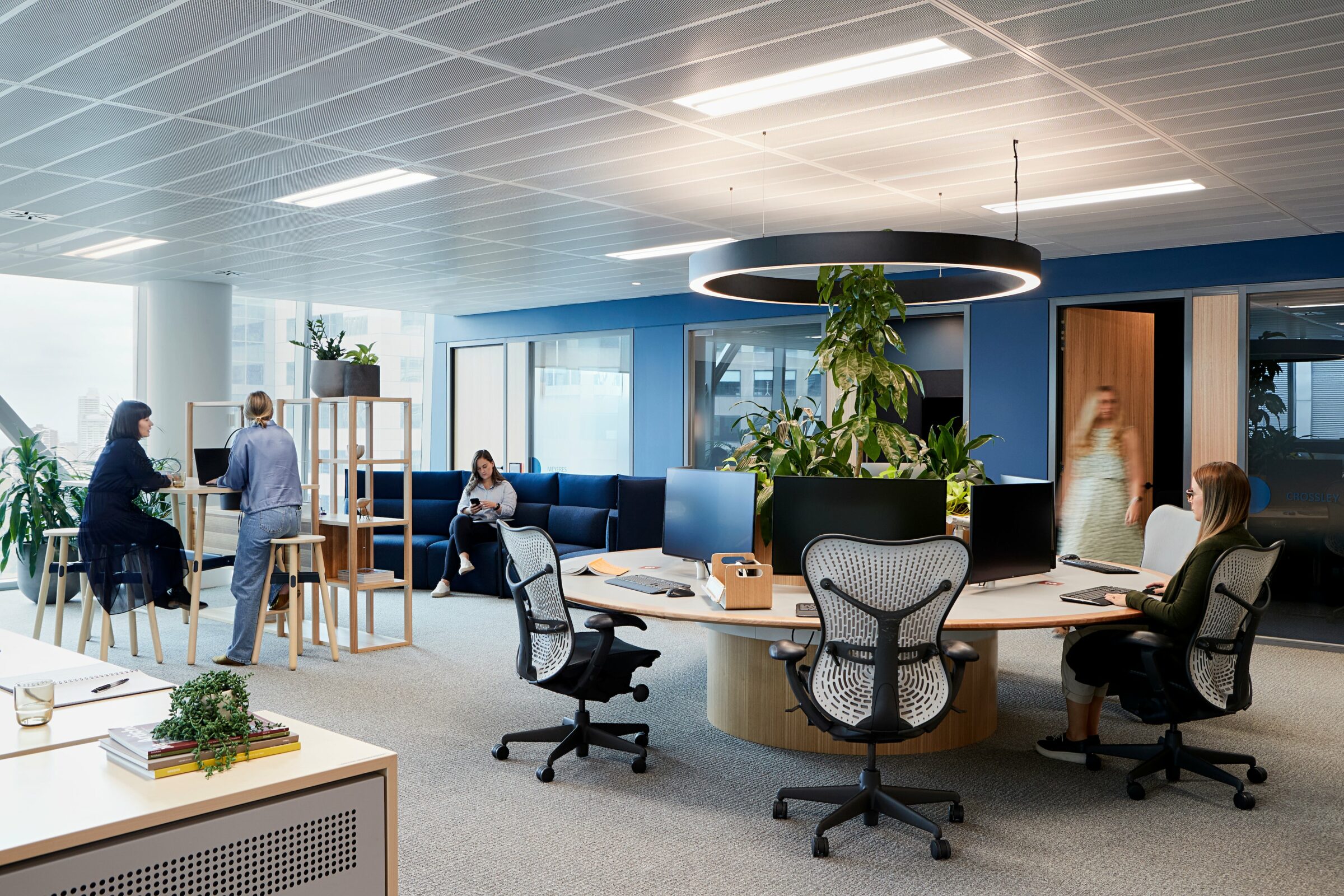
International Bank — WiFi Occupancy
- Finance and Banking
- Amsterdam headquarters + 23 regional offices
- WiFi Occupancy Measurement
- 3 fewer office buildings
Thomas More WiFi occupancy measurement
- Occupancy Insights: Real-time and historical WiFi-based utilisation data across 26 buildings in 7 cities.
- Automated reporting: Actual usage compared against the timetable automatically, every night. Trend analysis: Short-, medium- and long-term usage trends tracked across 60 different programmes.
- WiFi Occupancy Measurement +1 product

Gilde College
- Smart Workplaces in education
- Smarter space usage ~ 50% fewer desks
- Real usage data behind every decision
- Desk Booking +5 producten

Plieger Group
- Centralised content management across 80+ locations.
- Smooth check-in process with instant host notifications at reception.
- Simple, real-time meeting room booking for a seamless office experience.
- Digital Signage +2 producten

CFC Underwriting
- A Future Ready Workplace with GoBright and Kinly
- a smart office headquarters that supports its continued growth
- Room Booking +2 producten

Aston University
- Challenge: enabling staff and students to work more efficiently and embrace a truly agile campus environment.
- Solution: Enabling instant bookings, automatic room releases, and clear insights to optimise campus spaces efficiently.
- Room Booking +1 product

Land van Cuijk
- Bringing together five locations into one future-proof City Hall
- Optimising workspace by reducing desks with 50% using smart office solutions
- Digital Signage keeping employees and citizens informed
- Desk Booking +4 producten

KRUK
- Challenge: manage a hybrid working environment
- Room Booking +2 producten
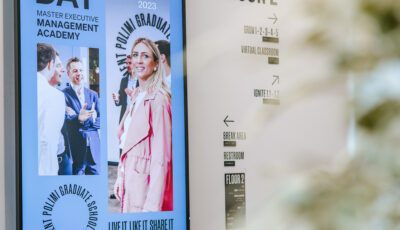

POLIMI University
- Challenge: allow space management and inform teachers and students
- Room Booking +3 producten
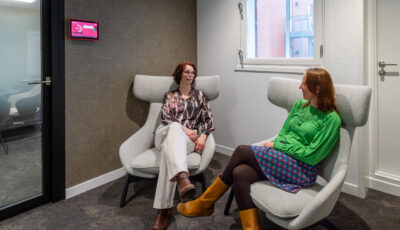
Municipality Noardeast-Fryslân
- Challenge: Boost collaboration and connection at the workplace
- Room Booking +1 product
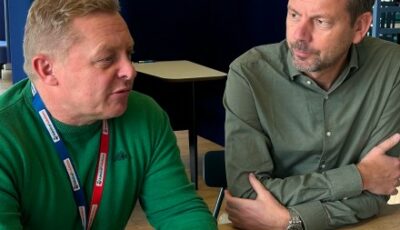

Admiral Group
- Challenge: Focusing on active collaboration
- Room Booking +2 producten

Viridium Gruppe
- Challenge: Finding the right balance with hybrid working
- Room Booking +1 product

IJsselheem
- Challenge: Boost collaboration and connection at the workplace
- Room Booking +2 producten

Subaru
- Challenge: Optimise hybrid working strategy
- Room Booking +2 producten

Dutch Railways (NS)
- Challenge: Streamline meeting room booking process
- Room Booking +1 product